Showing posts with label Goat meat. Show all posts

Friday, October 30, 2015

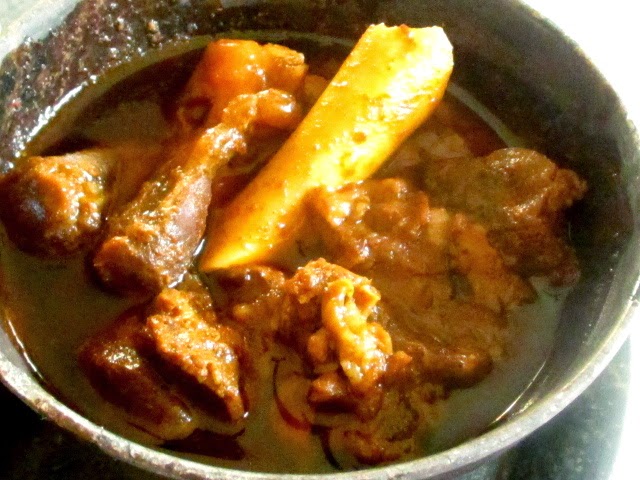
Coconut Poppy seed Mutton

Coconut Poppy seed Mutton 


The first time I slow cooked mutton was after reading an article where the author spoke to a member of one of India's erstwhile Royal families who harped on the beauty of a meat dish when it is slow cooked. That was it I slow cooked mutton , loved it and stuck to it and then there was this one time where the Cooking gas was delivered a month late than it was supposed to be delivered and the household was in a chaos. So for sometime I tried reducing the time taken for slow cooking by slow cooking in a pressure cooker for half the time and then slow cooking the meat which suited me not too badly but then again I must have not even known that in the corner of my heart I did miss slow cooking meat.

One of the wonderful things about interacting with people who are passionate about food is that sometimes matters related to cooking becomes even more clear to you. I am lucky to be part of a group where we have professional chefs and passionate home cooks interacting with each other and so I once again realized I had to slow cook meat and so I did and now its either slow cooking meat or no cooking meat. The flavour is amazing as is the texture of meat which is neither tough nor over cooked but sticks to its bones and melts in your mouth when you take a bite.

I love the flavour of coconut and spices so I was set on this spice mix from Lucknow which uses Charmagaz ( a blend of 4 seeds) etc but then alas I was out of charmagaz.

Thankfully I met with a friend who was talking about how people in our neighbourng state makes meat curry with Poppy seeds. And I knew exactly how I wanted my meat curry to be.

Marinating the mutton in raw papaya juice lessened the time of cooking by half an hour and in the end we licked our bowls clean with some piping hot rice.

From my personal experience the meat tastes even better if you leave it overnight post cooking where the flavours get absorbed even better and you have a wonderful breakfast or brunch for the next day.

800gm goat meat / lamb meat

For marination :-

1 tbsp ginger paste
1 tbsp garlic paste
1 tbsp raw papaya juice

130gm sliced onions
100gm yogurt

For the spice mix :-

2 tbsp heaped grated coconut
1 tbsp poppy seeds
2 blades of mace
3 green cardamom
1.5 inch cinnamon
4 cloves
4 whole dried Kashmiri Red Chilies
2 fiery hot dried red chili (choose a variant which is hot)

100gm clarified butter


Marinate the meat in raw papaya juice and ginger garlic paste for about 3 hours to 4 hours.

Heat the ghee and fry the sliced onions on low to medium heat till its golden brown. take care not to overbrown it. Add the meat and immediately lower heat to absolute low , cover and cook for 30 minutes. Keep it on low heat throughout.

Now whisk the curd well and add it to the meat and stir continuously till it forms a homogeneous mixture.

Now take the ingredients of the spice mixture and leaving aside the fresh grated coconut dry roast the rest and let it slightly cool down and make a dry mixture, add the coconut and grind further and then keep it aside.

When you have cooked the meat for 1 hour from the time you started cooking it add the spice mixture and salt  and lower heat sprinkle water and cover and cook for another 45 minutes to 1 hour till the meat is cooked through.

Keep sprinkling water and stirring every 15 minutes.

Once cooked cover and let the meat rest for 15 minutes and serve with hot piping rice

The resting period is crucial for better flavour and texture of meat.


Friday, April 3, 2015

Chicken Khirmich Pulao

Chicken Khirmich Pulao 

(Murgir Khirmich Pulao)


If one asks me about the exact moment when I got so interested in the kitchen I would not be able to give the person a straight answer. Part of it was because my mother who always stays away from the kitchen had taken up cooking delicious Chinese food when I was about 11 years old. It was more so delightful for me because I was usually an ostracized person in groups where people of my age group would brag about their mother's skill in the kitchen. What amazed was how close my mother's Chinese was to the food of old Chinatown from Calcutta. Unlike my friends who brought greasy Chinese which was doused in soya sauce or lacked the flavour my mother made balanced mild flavoured Chinese food which had amazed me. I had later learnt that she had learnt this from a friend who had studied hotel management. Then came a period when as with many teenagers I had a dramatic relationship with my ma and she stopped cooking and focused on her love of mountains. So perhaps it was to taste her delicious dishes that I started cooking Chinese food the ones she made at home. She had shared the recipes. That will be for another post.

If I close my eyes I see myself salivating while reading Enid Blytons books and the descriptions of picnic baskets and having this urge to taste all of them but the truth is I grew up among my maternal grandmother and aunt (mother's brother's wife) who left a deep impact on my mind about cooking. While my mother was the fiery no nonsense woman who was rough and tough I grew up in a world of drying lentil dumplings and making lip smacking Bengali dishes. My aunt's influence and an urge to imitate her filled me with an intense desire to learn the way she would render her magic to dishes. She is like a mother to me and taught me all that she knew about Bengali cooking encouraging me and appreciating my efforts.

What I learnt from her was mostly what had been passed down by her mother some 40 years ago hence I have the greatest regard for tradition when it comes to cooking.

Much later I realized that if I do really want to know about my Bengali culinary roots I must do what I believe if the only way to gather knowledge, that is read books.

What I discovered has left me brimming with pride for imagine this in Bengal women were publishing cookbooks at a time when emancipation for women was unheard of in most parts of the world.


Sunday, August 10, 2014

Rogan Josh (No onion no garlic)

Rogan Josh (No onion no garlic) 

Tribute to the Kashmiri pandits 


I was rummaging through my folders for a delightful recipe for gosht and I decided on some Mutton Rogan Josh. Now I have these recipes collected a good 10 years ago. A 16 year old me knew that I would one day want to cook all of them. Over the years out of the many collected Kashmiri dishes I have stuck to 3 of them but I realized I must try my hands on the forgotten ones and hence my decision to make Rogan Josh. What put me in a dilemma at first where these two recipes for Rogan Josh that I had. One used onions and garlic and cockscomb flower and the other didn't use any onion or garlic and used curd.


I immediately searched the internet for more information on Rogan josh and thankfully there is a very nice article on Wikipedia which clearly states that the Kashmiri Pandits make it sans onions and garlic and uses curd to cut down the heat while the other version uses onions and garlic and sues cockscomb flower.  To be fair I went through some of the recipes given and most recipes use way too many spices. To be fair both my recipes were simple and I decided to stick to them because I personally feel the same spices used for all curries mars the distinct taste. I chose the recipe used by Kashmiri Pandits , well at least the recipe I have on my hands because meat without garlic and onion has always fascinated me.


Before I move on to the recipe I have a confession to make. I do not enjoy  mutton unless and until it has a melt in the mouth texture but in way should it be too soft and disintegrate with the gravy. Over the years I have tried two methods of achieving this soft delightful texture. I abandoned my former method of slow cooking for 3 hours on low heat with a faster method which also involves slow cooking but uses a pressure cooker and saves time and fuel. As someone who switched I have to say it yields the exact same result but you must use the lowest heat possible even with the pressure cooker.


So here goes the recipe.

Serves 4 to 5

1 kg of goat meat from the legs
1 teacup of whisked curd (cups which hold 200 ml liquid)
3/4th  cup of mustard oil (cup which holds 200ml of liquid)
5 cloves
1 tsp cumin seeds
Pinch of asafoetida
3 cups of water
2 tsp dried ginger powder
2 tsp aniseed powder
4 to 5  green cardamom roasted and crushed
1 tbsp ghee
Pinch of saffron soaked in water
Salt as per taste - I needed 1.5 tsp
1 tsp turmeric
1 tsp sugar
1.5 tbsp kashmiri chili powder

Start by marinating the meat in the curd and leave it aside for 1 hour. Now heat the oil in a large wok and bring it to smoking point , lower heat and add the meat and immediately turn up the heat to seal the juices and keep frying and stirring for 2 minutes and then add the cloves , asafoetida  and cumin seeds and keep stirring till the oil separates and then add 1 cup of water , Kashmiri red chili powder , turmeric , salt and sugar and mix well and then simmer for 10 minutes.

Now take a big pressure cooker and put the meat in it. Add 2 cups of water , the dried ginger powder and aniseed powder, close the pressure cooker and cook on the lowest heat possible till the first whistle. Immediately turn off the stove after the first whistle and let the steam come out on its own.

Once it is ready open the lid and check the meat with a fork if the meat falls apart then take out the meat and put the gravy in the wok and bring to a boil adding the green cardamom , saffron dissolved in water  and ghee and then simmer for 10 minutes and add the meat and mix well and serve with hot rice .

In case the meat is not tender enough for you after you open the lid of the pressure cooker put the gravy and meat together in the wok and add the cardamom, saffron dissolved in water  and ghee and bring to boil and simmer for 7 minutes to 10 minutes. There you have melt in the mouth beautiful Rogan Josh .


Watch this space for the other version of Rogan Josh which is coming very soon for you 

Wednesday, June 11, 2014

Dum Biryani


Dum Biryani 


 Biryani is a cousin of the middle eastern Pilaf and the variety of Biryani which is available across South Asia (India , Pakistan and Bangladesh) is sure to amaze any culinary enthusiast. If you have grown up with a particular type of Biryani you will always have that funny little story when you tasted the other variety. So I grew up in Calcutta, the City of Joy, the City of Culture but also the city where the Nawab of Awadh had settled at one point of time bringing with him the glorious cuisine of Awadh. While there had to be certain economic changes made in the kitchen with the Nawab's glorious days behind him the basic of the recipe remains the same and so I grew up knowing the Calcuttan Biryani which is very similar to the Awadhi Biryani except that it has the additional potatoes and in some cases you can even add eggs but then again I was never really that fond of Biryani from the eateries in Calcutta because of the high amount of ittar and kewra water and oil . Well originally it is supposed to be ghee all the way but one of the reasons why Biryani is very famous in Calcutta is its affordable price and as we all know 'you can't eat your cake and have it too'. Nevertheless it was not until I had the tasted the Lucknowi Biryani available in only one eatery of Calcutta that I fell in love with Biryani all over again. Well I say all over again because while I was growing up I might not have liked the Biryani from eateries but that was only because come every Sunday and my father would make Biryani at home. It was of course not oily and had the balanced proportion of flavoured water which suited my taste buds and this Lucknowi Biryani brought back strong memories.

Now I am particularly fond of Awadhi cuisine but getting hold of recipes from Awadhi cuisine can prove to be quite difficult. While a few are found all over the place one should understand that more that the ingredients its the numerous methods of cooking that makes this cuisine so exquisite.

Well anyway going back to that time when I had Biryani from Bombay I was well completely taken aback and to be fair very disappointed . You see Biryani from Bombay has its own distinct taste which is completely different from your Awadhi Biryani with a curry like taste and it took me a while to appreciate it.

Anyway one fine day I decided to make Dum Pakki Biryani. Dum is a method of cooking on slow fire and the method I used for cooking was Dum Pukht where a curtain of dough seals the container and the food gets cooked in the steam. Now Biryani can not only be distinguished on the basis of the region it is from but also on whether it is made in the Pakki style or Kachchi style. While for the Kachchi style the meat is marinated and cooked together with the rice . The Pakki style Biryani cooks the rice and meat to an almost done state and then cooks them together.

Now here is the problem with 'authentic style' and why I am not calling my Biryani the Awadhi Biryani. I have never been to Lucknow and as I have said before there are not too many sources which gives you the recipe for Awadhi food and so I consulted two articles from the Times of India, recipes from two blogs and as much information as I could gather to make it as close to the original one as I can and here is why. While blogs are a great source for recipes some blogs are misleading. So I liked this blog very much and the blog talked a lot about certain details of what makes Awadhi Biryani so special and all the points to be kept in mind and then there are certain ingredients used which I immediately know makes it not  quite Awadhi and so I consult another blog and the article from The Times of India  and this is what I gather.


  1. The distinct flavour of the Biryani is imparted by cooking the rice in the 'Yakhni' or the meat stock
  2. The spices used are always kept whole and not ground.
  3. The rice grains are fluffy and the sign of a good Biryani is the grains remaining separate
  4. No oil of any kind should be used. Its cooked all the way in the mutton fat and ghee.       
  5. The quality of the Biryani will greatly depend on the quality of mutton. In India goat meat is also categorized under mutton and for this it is always goat meat that is used. 

Anyway  coming back to the recipe this one can easily feed 3 to 4
What you need :- 

500gm   of good quality meat with bones
2 cups of Basmati rice (cups which can hold 250ml of water) / Approximately 360gm of rice 

For the Yakhni 

7 cups of water (cups which hold 250ml of liquid)
1 black cardamom
5 green cardamom
5 cloves
1 inch cinnamon
4 blades of Mace
1 tbsp chopped ginger
1 tbsp chopped garlic
1 large bay leaf
1 tsp Shah Jeera
3/4th tsp black peppercorn
Salt as per taste (I required 1 heaped tsp)

To sear the meat

4 tbsp ghee
4 tbsp whisked curd
4 tbsp whole milk
1 black cardamom
3 green cardamom
4 to 5 cloves
1 inch cinnamon
2 blades of mace
1/4th tsp Nutmeg
Salt as per taste (I required 1/2 tsp)
Pinch of turmeric
20 black peppercorn
1 tsp chili powder

For layering

2 pinches of saffron soaked in 8 tbsp water
2 tsp rose water
7 tsp ghee

For the Birista (Optional) Usually not a part of the Awadhi Biryani
Birista means golden fried onions . If you desire to use it
Take 2 medium sized onions and chop them as finely as possible
50gm ghee for frying

For the seal to cover the mouth of your pot . Now this will largely depend on how big the mouth of the pot is :-

I needed 2 cups of flour
1 cup of water

Once the seal was opened 


Start by soaking the rice and then go no to make the Yakhni . Put all the spices for the yakhni in a muslin cloth and tie it up. Place everything together and bring to a boil and then simmer on low heat for 1.5 hours. Take out the pieces of meat after 20 minutes when its done to a 3/4th stage.

After 1.5 hours start by searing the mat. Heat the ghee and add the meat and saute on high heat for 1 minute and add the spices and reduce to low heat and add whisked curd and milk and keep stirring till you get a dry consistency.

Bring 4 cups of broth to a boil and gently add the rice. Be careful because Basmati rice is very delicate and the soaking will make it more vulnerable to breaking. Bring to a boil and then lower heat and cover and cook for 3 minutes to 5 minutes till its 70% done. It should be soft yet not soft enough to eat. Once done drain the rice and spread it out if possible and leave it under the fan for 5 minutes.

Now for the final Dum take your pot and grease it with ghee. I needed about 2 tsp and then add a layer of rice and some meat and 2 tsp ghee , 1/2 tsp rosewater and some soaked saffron. Add another layer of rice and meat and repeat it with the ghee , rosewater and soaked saffron. And a third layer of rice and meat and then roll out the dough and seal the pot and place it over the lowest possible flame with a lid on top of the rolled out dough and a heavy object on top. I used a stone mortar and pestle and leave it to get Dum Pukht for the next 20 minutes to 30 minutes and switch off the gas stove.

She or  he who shall peel off that layer of dough once done will be hot with a delicious aroma which is intoxicating indeed. Serve with raita.


P.S. In case you want to use the Birista fry the onions on low heat till its golden brown and use it for layering but traditional Awadhi Biryani does not use it. 


Sunday, March 30, 2014

Laal Maas


Laal Maas 

(A regal recipe from Rajasthan) 


 The truth is , for me virtual forums are a boon in life and here is why. You see you may have tried a recipe a hundred times but then somewhere these old favourites take a back-seat with new recipes to be explored,  healthy diets to be followed etc. Currently Kolkata Food Bloggers is hosting this amazing East or West Food is the best event, which explores regional cuisines from across western India to the far eastern states. Located in the extreme West,  Rajasthan is the state I picked for this event. There is something mysteriously attractive about this state which has always drawn me to this magnetic land of princes and princesses. Popularly known as the 'Land of kings' my earliest memory of this state with its rich cultural past is Abanindranath's 'Rajkahini' (A member of the Tagore family who wrote these mesmerizing short stories about regal Rajasthan) which captured my fancies when I was a child and continues to do so even today.


What one needs to know is Rajasthan unlike other states of India is a very dry state. After all , the Thar desert is located in Rajasthan and its culture and cuisine has developed accordingly . So most dishes use a lot of clarified butter to keep one's skin from drying out. It also uses a lot of spices and the fiery Rajasthi lal mirch.

Legend has it that the Regal families from Rajasthan would go hunting and the royal chefs would develop these amazing meat based dishes and Laal maas is one of them. Even with the unusual number of dried red chilies used , it is fiery yet not so fiery that one feels choked because all that fiery red chili remains whole and the flavours come from assorted spices. I was lucky enough to stumble upon this article when I was searching for information about regal Rajasthani cuisine. You may have a look at this article if it interests you.


What I gathered from the article was that the important part of the recipe is the browning of onions and the meat and the long hours of cooking to achieve that melt in the mouth texture of the meat.


As usual the website is filled with numerous recipes of laal maas. I have personally followed one I had gathered from 'The telegraph' Calcutta, years ago and have loved the taste. Even though it might sound rich and the process very tedious I suggest you follow it to indulge in that regal experience once in a while.

What you need is :-

1kg goat meat (the lean part)
400gm onions sliced thinly
4 tsp minced garlic
1 tbsp cumin seeds
16 whole Rajasthani dried red chilies
Salt as per taste
4 tsp heaped Rajasthani dried red chili powder (lal mirch powder)
4 tsp ground coriander seeds
350gm ghee to 400gm ghee
10 black cardamom
10 green cardamom
350gm thick curd whipped


Start by marinating the meat with salt and 1 tbsp ghee. Marinate for 2 hours and then heat the ghee and add the cumin , when it splutters add the garlic and when the beautiful aroma hits your nostril add the whole red chilies and the onions and then brown the onions on low heat, when browned add the meat and seal the juices on high heat for 4 minutes or so and then lower the heat and brown it completely. This process of browning takes about 30 minutes to 45 minutes. Add the coriander powder, salt , red chili powder and then keep stirring till the spices are mixed well with the meat, add the whipped curd and bring to a boil and then lower heat and cook for the next 30 minutes to 45  hour. Now there was a time when I would waste a lot of  fuel and cook it on low flame for 3 hours or so. I have learnt a trick for domestic cooks which saves fuel and yields the exact soft meat and retains all the flavour. Use a heavy bottomed pressure cooker and simply transfer everything from the big wok in the pressure cooker and then seal it and put it on low flame allowing the steam to develop very very slowly. It takes about 20 minutes to 30 minutes and then wait for 2 whistles and let the steam come out on its own. Here you must be patient. Once the pressure is lowered to the point where you can open the lid open it and transfer it back to the wok and now you need to be careful because your meat is already soft enough and for that melt in the mouth experience you need to bring it to a boil and simmer for not more than 5 minutes to 7 minutes because if simmered for a longer period the meat melts in the pan instead of your mouth and no one wants melted meat in a mass of gravy. Once you have simmered the meat put it through the fork test to understand the softness . What you do is  take a piece of meat and try and take out a bit with a fork and it comes off you know the meat is done. Now turn off the gas stove and use a lid to cover the pan and let it stand for sometime and serve with some hot Chapati.

This is part of the event,